Thursday, May 9, 2013

Bye Bye to Summer 2012/13

We have just completed a long, glorious, typical Wairarapa summer - day after day of cloudless skies, hot sunshine, and grass rapidly changing from lush green to crackly brown.  Lovely stuff if you're not a farmer.  Lawn mowing just didn't happen and pasture disappeared.  Passing landscapes on the highway became dusty fields of brown earth and yellow stalks, bereft of grazing animals.  At Fossils Retreat, we suffered, having to resort, yet again, to grazing the long acre on our dead-end road when we were able.  No hay was able to be made, and we had to buy in hay and baleage.   We had hoped to sell our lovely 1 year old bull calf, Paddy, and our heifer calf Dawn, as well as Clarissa, who we are pretty sure is in calf, but there wasn't much point as nobody had any grazing and everybody was offloading stock left, right and centre.  The Wairarapa region was officially classified as a drought region.  Towards the beginning of April, we got hooked up with a flutter spinner and a long alkathene hose, which enabled us to water two of our paddocks and keep up the grass growth.  As the long, hot days continued, but the nights became cooler and we started to get a dew, we started to get field mushrooms, and boy oh boy, did they come up over the next few weeks.  Then some rain, with more fine days.  We had mushrooms coming out of our ears, basket upon basket of them every day.  We made soups, sauces, ate them cooked in butter every second night, and traded them for fresh figs, lemons, other produce and pig food.  We have just had our second frost, so that's just the end of them now.


Yummy field mushrooms and a bountiful supply of our free range eggs

The Patricias and the rest of the hens were finally established in their new house, complete with run, which has been located in the paddock where our barn is (a long way from the vege garden!).   They get let out after they have laid their daily eggs to have a forage round and literally 'free range'.

Finally - the new chook house.  A long time in the making.  I doubt this one will blow over in a gale.  Still to be painted

Our vegetable harvest was not nearly as prolific as the previous year.  This year, no doubt due to the drought, our potato yield was perhaps one third of the year before.  The Patricias did not help though, as they still managed to find their way over and scratch and take dust baths in the beds.  We got a tremendous flavoursome yield of onions and garlic and lots and lots of basil, which we used to make copious quantities of pesto.  We have found that it freezes successfully, so we are hoping to have enough to last us well into the year.

We lost a few shelter belt trees due to the drought.  Funny, several in a row and then a dead one.  Our feijoa hedge is coming along, although a bit higgeldy-piggeldy as we have had to replace the odd one or two.  We had an inspection the other day, and it looks like we can look forward to a few dozen feijoas this season.  Friends have already started donating some to us.


Denise pulling down willow branches for Paddy and Walter to munch on during the drought.  Note the scarcity of green grass

Our three pigs - Milly, Molly and Mandy - are thriving.  These are really nice little pigs.  They will be with us for another 5-6 weeks.  They get let out of their yard to free range, dig up the paddocks and investigate along the river bank, and come running home back to their pen each night to be fed as soon as they catch sight of you with the feed bucket.  We have been very lucky with friends contributing towards their welfare in great style - surplus apples, squash, pumpkins, figs and a huge drop-off of acorns, all of which have been gratefully received.  We are at the stage now of finishing them off and packing them full of good food, so it will be interesting to see whether the acorns have any effect on the taste of the pork.  It has just got cold enough to start lighting a fire each night (we've had two frosts to date) so their tucker in the morning consists of warm peas and crushed grains which have been cooked in the stock pot and left all night on the wood burner.

Mandy, Milly and Molly rooting around in the mud on the bank of the water race a few weeks ago

So, it has been a busy year - it's always a busy time.  We are upgrading our driveway, putting down permanent paths and edging around the vegetable gardens, thinking of new ways of Patricia-proofing our summer beds, attending to ongoing maintenance, setting up and taking down electric fences, pruning back willow tree branches, splitting and chopping firewood, keeping the woodshed stocked, lawns, line trimming, ongoing sheep maintenance, feeding out hay and baleage to two lots of cattle twice a day - we don't need to join a gym!  And there is exterior house painting to be done as well;  garden beds to plan and prepare.  When winter really sets in and the nights draw in (it's pretty much dark now by 5.45pm) we have lots and lots of scraping and painting to do indoors!  Will we ever be able to get our deck done?  Will we ever have time to sit on a deck with nothing better to do than enjoy a gin and tonic in the evening?  But we love our lifestyle - wouldn't swap it for worlds.  There is something immensely satisfying in coming inside each night (to a fire already lit!) to a warm house, with all animals fed with full stomachs, taken care of and settled for the night.

Thursday, April 4, 2013

Meet The Patricias

A few months ago, we increased our small flock of chooks, purchasing six Hyline point-of-lay pullets. The Hyline breed has been developed solely as egg layers - the majority of eggs bought in supermarkets etc. are from Hylines. They have proven to be lovely layers, consistently giving us very large (some double yolkers) brown eggs. It didn't take us very long to discover that our newcomers are very social, as well as inquisitive, birds. When you approach them, they squat down, spread and flatten their wings, and beat a steady rat-a-tat tattoo with their little feet. They also like a pet and a cuddle.

Here's the story on how they became known as 'The Patricias'. We were watching a program on TV about a woman and her pets, and she had a hen called Patricia. We thought that was a pretty nice name for a hen. Whilst Jennifer was out and about in the garden a few days later, she happened to remark that one of the new hens was very friendly; always hanging around, always squatting and tattooing and enjoyed being picked up. Almost continually in fact, to the point of being a little annoying. She became known as Patricia. Then it was discovered that it wasn't just Patricia who was always being inquisitive and looking for a cuddle - it was all six of them coming up one by one. As we can't tell the difference between them, they are now,collectively, The Patricias.


The Patricias, helping to dig a hole for a new tree, heading for a speedy decapitation from the spade

The Patricias have, however, become somewhat of a nuisance as far as the vegetable gardens are concerned. They have been cramped in their living quarters, and as we market our eggs as being free range, they are let out to roam early to mid morning. It didn't take them long to roam over to investigate the vege gardens. And cause destruction and mayhem.


The Patricias getting their daily greens. Note the stalks at the back of the bed. There was a really nice crop of silver beet in this bed. Seems that they're not too fond of lettuce. A couple of rows of carrots just germinated at this end of the bed are no longer.


Another reason why the vege beds are so attractive. Dust baths! If there are any plants in the way that they find unpalatable, they just get scratched out. Out with the baby carrots, parsnips, peas and beans!


                                                Resultant vege beds 'Patricia proofed'

We did have some success with some vegetable crops this past summer - obviously, with those plants the Patricias do not care to eat. A bumper crop of both Kakanui and Elephant garlic, and prolific crops of both Pukekohe and Red onions. We have managed to grow good crops of basil this past summer as well (in Patricia proofed beds) and as our summer has been long and hot, we are still producing copious jars of yummy pesto.

                                 
                                       Drying out some of the harvested onion crop ...


                                                ... helped of course, by the Patricias

So, what to do about the Patricia invasion of the vegetable beds? We have never envisaged high fences all around the beds (the expense would be horrific, for one thing), and after last winter's early storm bomb which nearly demolished our purchased chook house, we have decided to build a strong, solid structure and put it out in the barn paddock, with a large run

      A more permanent structure for the hens under construction, supervised by Madge

Our total number of hens is actually ten - six Patricias, one Favorelle (Hannah) and the three Plymouth Barred hens she hatched (unnamed). The latter four are not nearly as friendly and sociable as the Patricias. Nor are they such a nuisance.  And what of little Lucky who survived the Great Storm Bomb of the winter of 2012?  She was not herself for a couple of days a few weeks ago, so we isolated her but she lost all interest in food and passed away in her sleep.

Nothing is sacred to the Patricias. They will come inside if the outside doors are not closed, clean up any cat food left in the cat dishes, cruise the bench and counter tops to see what there is to snack on, and have been responsible for ruining a plate of chocolate eclairs. No, we do not encourage them to come inside, but over our very hot recent summer, it has been difficult to remember to keep closing the doors when coming in from outside


Thursday, September 27, 2012

More Arrivals and Departures

Our population has gone up and down.  Beatrice, our last ewe to lamb, produced a lovely little girl last Friday.  Beatrice, along with Barbara and Bianca, are our first three ewe lambs born at Fossils Retreat.
Proud Mum, Beatrice, with baby Diana - 1 day old.  Another hit by the mystery paintballer

Lambing is now complete - we had five ewes lamb, with a lambing percentage of 140%.  In contrast to last year where we appeared to produce nothing but rams;   of our seven lambs this year, four are ewes which we will keep for future breeding.  All the ewe lambs are black with white 'paintball' hits, and the breed is known as 'Wiltidorp' - a Wiltshire ram over a Dorper ewe.  All are doing exceptionally well and putting on weight magnificently.

We have also procured another six hens - point-of-lay 'Hyline' pullets which are the breed most commonly used to lay commercial eggs.  Our three Plymouth Barred Rock hens are/should be laying now - one went broody and had to spend a few days in the sin-bin (converted cat carry-cage).  Right now, the Hylines look some weeks off egg producing.  Makes one truly realise what the term 'hen pecked' really means when you see the treatment metered out to the newcomers by our existing five girls.

Not a very clear picture, I am afraid, of our newcomers - they are the brown ones at the back of the pen

We also have some visitors at the moment - a mother duck who proudly does the rounds of the paddocks showing off her little brood.

If you look about half way up the photo, towards the right hand edge, you will see a little broken brown line that actually is a visiting Mother Duck with 9 little ones.  She wouldn't allow us any closer to get a good photo.  She started off with 12 babies, then we noted there were 9, and today I note there are only 6 left.  Maybe they will remain the sole survivors as they are now getting a little bit too big for hawks to swoop down on

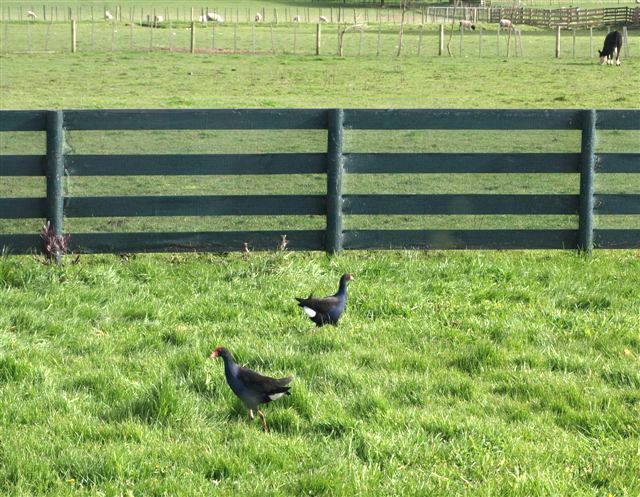
More visitors - Pukekos on our lawn.  The dogs were tied up when this photo was taken - you don't see the pukeko when the dogs are loose!

Departures - Zita and Zelda are but fond memories for us now, having met Vic, our homekill agent.  Charley Farley (a.k.a. Stumpy), Bonnie's vertically challenged Dexter steer, is next to board the angel train - Vic is due down to meet him in 3 days' time.  Also departing us then will be Cedric, our last of last year's male lambs

Wednesday, September 5, 2012

All the New Lambs

All our lambs arrived within 10 days, and all six except one, are the unique black colouring with white splotches - looks like they have been the target of paintballers!  Of the six, three are ewes and three are rams

Dasha, with mother Annabel

Derek, Delia and Dasha - a.k.a. The Three Hoons.  Coming up for 3 weeks old in this photo

Grab them young for a cuddle, as they get pretty speedy at avoiding catching at a few days old

Bianca was a first-time lamber, and produced tiny but healthy babies - Duncan on the left who is the only one throwing back to his Dorper mother, and sister Dixie

Our lambing went well, with only one yet to lamb, who is Beatrice, who had an early lamb late last season, so may not have come in heat as quickly as the others.  We are still not sure whether she is in fact going to produce a lamb or not.  Barbara went in to labour but was having difficulty birthing, so we took action, delivered a big ram lamb then discovered the birthing problem was due to a very badly presenting second ram lamb which unfortunately was dead when we removed it.  Her surviving ram lamb is nice and big and healthy, called Dante

A shot of all the lambs frisking around and boing-boinging

With another very wet but very warm winter, we have had our fair share of the usual feet problems with the Dorper sheep.  Apparently, their hooves grow faster than most breeds and especially so in wet weather.  With all the surplus water in the paddocks and muddy, pugged yards, it has not been easy dealing with feet trimming and additional treatment for footrot for some and scald with a couple of the babies.  Roll on summer, daylight, and sunshine!

Sunday, August 5, 2012

The Black Sheep of the Family

Meet the Black Sheep of the Family ...

Abigail produced our first lambs of 2012 - twins on Saturday 4 August - a ewe (DELIA) and a ram (DEREK)

This is really interesting, as our new Wiltshire ram, WILLIAM (who has obviously performed) is white, and no, none of our neighbours had a black ram.  We will be looking forward to seeing what colours our remaining four Dorper ewes produce!


Tuesday, July 31, 2012

Wet Wet Wet Winter

Here we are, on the brink of August and again, it's another wet winter.  Although temperatures have been much milder generally and it surprisingly appears we are getting a small grass growth, the constant sloshing and pushing wheelbarrow loads of hay through slush and hungry animals fetlock deep in mud along the fencelines constantly  bellowing for 'More Hay, More Hay' is getting a little depressing.

We had rain last week, a couple of days of beautifully fine but cold, crispy days with heavy frosts, and we are back to the rain again.  We have looked up the long range forecast for the next 8 days, and it is rain, rain, rain every day.  Our hay situation might be getting a little critical as most of the paddocks have more than their fair share of mud and any remaining grass trampled in.

We have five sheep in lamb this year - two of our original Dorpers (the only two remainders of our original four) and three of their offspring from the year before last.  Looking good as far as William's performance goes (William being the young Wiltshire ram we bought earlier in the New Year).  Mostly in the Wairarapa, the ram goes out with the ewes on 1 February, but we held William back until the first week in March.  With a gestation period of approximately five months, we can expect lambs from early next week on.

Some of our hens have started laying - in particular, Hannah (the hatcher) and Lucky (who defied the storm bomb).  This is a nice surprise with it still being officially winter - we're getting maybe three eggs every two days.

 The hens are reposing back in their flash condo that we showed you a few months ago that got a bit busted up in a bad storm.  A friend of ours has painstakingly fabricated new pieces and glued and fixed all the parts back together.  The house is now reposing on our garden lawn as the ground is much flatter, as against in the adjacent paddock where the barn is where it runs the risk of being pushed over by four exuberant calves.  The downside of this is that they are wandering nearer and nearer the house, which may seem 'cute' and 'farmhousie' to some folk, but it's not so great when chook poo is being tramped through the house.  Two of the Barred Rock 'chicks' in the foreground who will be laying very, very soon, with Hannah (who reared them) at the back

With all the miserable wet weather, we have managed to get on with a few more things inside the house, like finishing off painting woodwork, replacing hardware, etc.  The reason we have not shown you any photos of any of our house interior, is that we do not yet even have one room that is totally finished!

We got above-ceiling and under-floor insulation installed last week, which has made a huge difference.  It no longer feels like the South Pole when you open the door into the hall.

                                
Well, lookie here - a fine day!  Yes, folks, we did have two fine days in between the rain last weekend, albeit with a very chilling northerly wind.  Here's the whole damn family grazing Bonnie and Bella on our long acre


                                         And here's Madge, the supervisor

Surprisingly, the days recently have not been too icy and our house lawns were mowed on Sunday (the above fine weather day), showing that there has been some limited grass growth.  We will be utilising our long acre over the next few days when one of us is home and can get two cattle out at a time as they require constant monitoring.  The tape across the road is not electrified.

Bonnie and Bella's calves, Dawn and Paddy, were weaned off them just over a week ago.  Such a terrible bellowing for 3-4 days;  not so much from the babies, but from the mums.  Paddy and Dawn are now with Walter and Wanda, our foster calves from the year before (10 months old) and are being cosseted with barn shelter, feed nuggets and ad lib hay.  They are about 4 1/2 months old now.

Thursday, July 19, 2012

A Day Off at the Seaside

We felt we needed a little cheering up one day last week and a break from 'getting on with things' on the property, so rewarded ourselves (and Tansy) with a picnic on the coast.  After several days of rain, we were lucky enough to be blessed with a perfect winter's day, and set off for Castlepoint, 69 kms north east of Masterton.  Castlepoint is famous for its lighthouse, annual horse races on the beach, and 160-metre-high Castle Point rock. It is popular for holidays and fishing, and has a safe swimming beach and tidal lagoon. 

Castlepoint takes its name from Castle Point, the impressive rock outcrop at the settlement's southern end. The rock was named by the British navigator James Cook in 1770, presumably because the landform resembled a fortress.   Castle Point is one of Wairarapa’s most spectacular landforms. It is made of successive layers of lime and sandstone, deposited over the last two million years. On the seaward side it sits on an older base of siltstone. As the land rose from the sea, the encircling softer mudstone was eroded, exposing harder limestone.


With its strong winds, shallows, reefs and currents, the eastern Wairarapa coast can be dangerous. Since 1849, 31 vessels have foundered there and 31 lives have been lost. In 1913, a 23 metre high lighthouse was built on Castlepoint reef. It is New Zealand's third highest lighthouse and sends three flashes every 45 seconds, visible for 30 kilometres. The last lighthouse keeper retired in 1958, due to automation.


After an invigorating walk up to the lighthouse and back, we headed north to the much less occupied Mataikona, about 20 minutes' further drive.

Looking north towards Mataikona - taken from the path leading up to the Castlepoint lighthouse

Mataikona could be best described as an 'olde worlde' lightly populated beach settlement.  No store, pub nor garage.  Very few permanent residents.  Lots of baches.  This place must really hum over Christmas/New Year


Amazing rock formations at Mataikona beach. This is close-up detail of one of the rocky 'channels' shown in the other photo


So, we had a lovely day off.  A super bonus was finding a nice big deposit of kale seaweed very near the spot we chose to have our picnic, so came home with a garbage bag full to make seawood fertilizer and foliar spray.

An Update on the Cattle & Other Miscellaneous Topics

We have 10 cattle on the property, which we feel is really too many to be carrying on our small acreage, especially after a few very wet spells so far this winter which has left some paddocks quite badly pugged.  We are keeping a close eye on our hay stock and hoping we have enough bales to see us through until the spring grass starts growing again in September, without having to buy more in.  We have three at 21 months - Zelda, Zita and Charley Farley (aka Stumpy) - who will all be getting acquainted with Vic the Homekill in August and September.  Zita and Zelda are Hereford/Friesian crosses, and Charley Farley is a pure Dexter steer courtesy of Bonnie.

A nice shot of Bella with her current pride and joy, Paddy the bull calf.  Paddy is 3 months old in this photo.  Present plans are to  keep Paddy as a bull, as he is turning into a lovely little chap with good constitution, and hopefully selling him before next winter

We still have Clarissa, Bella's calf from last year, who is currently in with Bonnie and Bella and their two calves.  We are hoping to obtain the services later this year of Legend the Dexter bull again, and Clarissa will be put to him.  Current plans include also selling her if she is in calf.  She needs dehorning as you can see, which will be a messy job.  She is a timid wee thing so we need to do a bit more work in handling her before getting the vet up again.  She was scheduled to have been dehorned a few weeks ago when the vet came to burn out Paddy and Dawn's buds (little bumps of horns starting to grow) but she jumped out of our yards, damaging the top rail of a gate.

In this shot taken the other day, Paddy is now 4 months old and is very interested in Clarissa, who is currently on heat and is actually his half sister.  That could be seen as a bit of a worry at his tender age considering he is not yet weaned, but good as far as prospects of hopefully selling him as a breeding bull are concerned


Bonnie bellowing for hay in a very muddy paddock.  Her wee calf, Dawn, is 4 1/2 months in this photo

Our two Hereford/Friesian calves from last year, Walter and Wanda, are now 10 months old and are being cosseted through winter.  They will have two new companions from this weekend - Dawn and Paddy.  It is time these two were weaned so mums can recover before we get the bull in, hopefully October some time.

Wanda in the improvised chook house

and


Denise in the dog house.
Taken during construction of Kate's kennel, which was done on the back of the ute to keep it all nice and level

A nice (but technically not a success) panoramic view looking east taken on a frosty winter's morning

Wednesday, July 18, 2012

We Now Have Eggs to go with the Bacon

Way back in the New Year about late January/early February, we decided to get another couple of pigs.  They turned out to be the nastiest natured pigs we have had to date (these were our fourth batch).  We found it difficult to name one nice attribute between them.

                       The two new girls, appropriately named DARKIE and DOTTIE

Dottie turned out to be a Number One Bully and an absolute Houdini who could worm sideways through a 7 strand post, wire and batten fence, like a natural sheepdog.  Consequently, when they were running loose in the back paddock (which they invariably were when one or both of us was home) she was a huge pain if she caught a glimpse of you in the distance which prompted a wriggle-through the fence and a speedy arrival of Miss Nosey Parker accompanied by high pitched cries of frustration from Darkie left back in the original paddock.

Fortunately, Kate, who has made it very clear that SHE DOES NOT ROUND UP CATTLE, THANK YOU VERY MUCH - ONLY SHEEP - became our self-appointed house guardian, dissuading Dottie from wriggling through the fence wire to chase up dinner by barking furiously and monitoring our home paddock fence line.  When either of us appeared with the dinner bucket on our way to lock them in their yard, they would run behind you squealing, with Dottie very fond of nipping you on the back of your legs.  And they can hurt!  They both became very fond of learning to balance on their hind legs, which they both did constantly, jumping up to push against gates as you were trying to let them out and trying to nip your hands as you were fumbling with the gate latches.   Such fun after heavy rain when one became spattered in mud!

They were a little late in getting dealt to due to our processor being inundated with work which is normal at this time of year as there is little grass growth and surplus stock are consigned to the freezer.  Believe us, we were counting down the days until Home Kill arrived.  And, they were getting very big.  Folk were very generous keeping us provided with plenty of surplus fruit this year, so they were fed on a surplus of apples and feijoas.

Vic, our Home Kill operator and his worker, skinning the bristles off Darkie in            scalding water while Dottie hangs around watching

We are now officially getting eggs.  The Plymouth Barred Rock chickens we hatched from eggs are now 16 weeks old.  We ended up with 3 hens and 1 rooster.  The hens are now at 'point of lay' which means we can expect eggs from them any time from now on, especially now that we are 1 month past the shortest day and the days gradually getting longer, but our eggs at present are coming from Hannah (the hatcher) and Lucky (who survived the storm) who both lay in separate nests among the hay bales.  They are still in temporary quarters without a proper nesting box, but that's another story ...  At this stage we are getting about 3 eggs every 2 days, on average.  It's so lovely having your own free range fresh boiled eggs!

Now, this is a photo of the HENS, not the cows who are obscured by the fence.  Hannah far left, the 3 Barred Rock Pullets and little Lucky, and Randy the Rotten Rooster to the right
A handsome fellow though he is, Randy is going to meet his maker and become Coq au Vin in our slow cooker, we have decided, this weekend.  He is just too bullying and greedy with his raping and pillaging and is becoming a nuisance.   As well, he is exercising his vocal chords these days and we don't need to be woken any earlier than we are at present!

Hot Air over the Countryside Again

Wikipedia Report :

On 7 January 2012, a scenic hot air balloon flight from Carterton, New Zealand, collided with a high voltage power line while attempting to land, causing it to catch fire, disintegrate and crash just north of the town, killing all eleven people (ten passengers and the pilot) on board. It was the deadliest air disaster to occur in mainland New Zealand since the July 1963 crash of New Zealand National Airways Corporation Flight 441 in the Kaimai Ranges, and the deadliest crash involving a New Zealand aircraft since the November 1979 crash of Air New Zealand
Flight 901 into Antarctica's Mount Erebus.It was also the second-deadliest hot air balloon disaster on record after a 1989 balloon crash in Australia that killed 13 people.

The balloon was a Cameron A-210 model, registered ZK-XXF and named Mr Big. The envelope was manufactured in the United Kingdom in 1997, and was initially used in the United Kingdom before being purchased and imported into New Zealand by Early Morning Balloons Ltd in 2001. The basket and burner system, capable of carrying ten passengers plus pilot, were manufactured in 1989 and were previously used with a Thunder and Colt 160A envelope before the envelope was retired at the end of its useful life

    ZK-XXF, the balloon that crashed

The balloon took off at 6:40 am from its launching area in Carterton, a town of 4100 people in north-eastern Wellington Region, on a 45-minute scenic flight over the Carterton area, carrying ten passengers.  The Masterton-based pilot was one of New Zealand's most experienced balloon pilots, with more than 10,000 hours flying time, and was the safety officer for the "Balloons over Wairarapa" hot air balloon festival, held annually in March around the Carterton and Masterton area.  The ten passengers were all from the greater Wellington Region.  At the time, the weather was clear, with sufficient light and little wind.  Data collected from weather stations at six nearby vineyards confirmed that the wind was mostly calm with occasional gusts up to 11.4 kilometres per hour (7.1 mph) from the north-east

The accident occurred around 7:20 am, when the balloon was attempting to land after completing a partial figure-8 flight pattern over the Carterton area. The pilot had indicated to the chase team he was likely to land near Somerset Road, a rural through road just north of Carterton in the locality of Clareville. At first the balloon was heading north-east over Somerset Road, around 700 metres east of the road's intersection with State Highway 2. Around 400 metres north of Somerset Road, the balloon reversed direction and headed back towards the road. The two chase vehicles, carrying some of the family members of the passengers, positioned on the road ready to assist with the landing.

Eyewitnesses saw the balloon climb and drift east towards a 33 kV subtransmission power line running perpendicular to the road, one of the two sub-transmission lines that connected the Clareville zone substation, which supplies the Carterton township and the surrounding rural area, to the national grid at Transpower's Masterton substation. The pilot was heard shouting "duck down" as the balloon came in contact with the power line around 85 metres from the road. One of the conductor wires was caught over the top of the pilot's end of the basket, and the pilot attempted to get the balloon to climb, but the tension of the wire prevented it rising and instead the balloon slid along the conductor. Around 20 seconds later, electrical arcing occurred, causing the cane basket to ignite in flames, and causing a phase-to-phase short circuit, tripping the line and causing the 3800 properties supplied by the Clareville zone substation to lose power.

Two of the passengers jumped from the balloon, still ten metres in the air, to avoid the fire, falling to their deaths below. The conductor wire on the power line then snapped, sending the balloon shooting upwards, as the balloon basket fire intensified and began to catch onto the envelope. One hundred and fifty metres in the air, the envelope disintegrated, causing the balloon to fall towards the ground, with the wreckage landing in a field just south of Somerset Road, around 600 metres east of the SH2 intersection.

Emergency services were quickly on the scene but, shortly after they arrived, ambulance staff found that all eleven people had died at the scene, and this was later confirmed by police. The bodies of the two people who jumped from the balloon were located 200 metres (700 ft) from the crash site. One of the four propane gas cylinders from the balloon was found leaking at the scene, with the other three found empty.

Weather conditions in the Wairarapa between the months of January and end of April are considered ideal for hot air balloons.  These flights are usually organised first thing in the morning when there is little or no wind.   All the hot air balloons in the country were grounded after the tragedy while they underwent comprehensive safety checks.  Every year, the Wairarapa town of Masterton hosts the 'Balloons Over Wairarapa Festival' in early March and this year, it was unknown for some time whether or not the festival would go ahead.  In the end, the vote was to hold the festival with a special tribute to those who died in the tragic crash on 7 January

Balloons Over Wairarapa 2012

We often get to see balloons in the skies when we are up early in the morning.  We saw the ill-fated ZK-XX, the balloon that crashed, to the north about 20 minutes before it went down.

This photo taken shortly after 7am from our front gate, looking east, towards the end of April

Two balloons landing beyond the ridge to the west of Fossils Retreat

It's All About Madge ...

 Meet the Gymnast - can't resist an open window - entering
the house from the roof


Fur Rules!


Every Dog Should Know Its Place


Still the Cleanest Bottom in the Wairarapa


                                                         A Favourite Yoga Stretch

Tuesday, July 17, 2012

More on the Produce Part 2

After a reasonably encouraging result from a few broccoli plants last year, we filled a 2x1 metre bed with some healthy little plants earlier this year towards the end of summer.  We didn't get a chance to check on them for several days and when we did so, this is what we found :

Hmmm - looks like it's home-sweet-home for white butterflies.  This photo was taken at the beginning of April

Now as we knew this was tasty fodder, we became more vigilant in inspecting these little what were, healthy wee plants.   We had a couple of severe frosts at the end of April, and then thought that that would be the end of the white butterfly caterpillar carnage.  Silly us!  Now that we are well into July and have already started harvesting broccoli heads, amazingly, we are STILL also harvesting plump green caterpillars, after recent gales, storms, heavy rain and stiff frosts.  The plants are sturdy enough now to give each a jolly good shake which throws these little blighters onto the soil, from where they are picked up.  A weekly 'shake' is still producing 10-15 caterpillars which are then gathered up and speedily disposed of by the chooks

A typical harvest of fat little caterpillars.  As well as being masters of disguise blending in perfectly with broccoli stalks these little buggers have the stamina of an Olympic champion with an equivalent voracious appetite

We also tried growing corn and sunflowers directly into cow patties in the spaces of our north shelter belt but again - too many gale force storms and not enough sunny days to produce any harvests.  We had reasonable success with zucchini and scallopine - again - had the weather been kinder we would have had better results.  A so-so crop of peas;  reasonable bean crops.  We also grew celeriac and kohl rabi for the first time.  Celeriac grew well and the kohl rabi not too bad.  A great crop of yams and jerusalem artichokes.  Greens grew well.  Peppers and chilli plants were swamped by the sprawling tomato plants, and for the second year, basil failed to grow satisfactorily.  Having discovered the joys (and cheapness) of producing your own pesto, we will give basil one more try this year with a little bed all of its own.

In a week or two we will have completed all our raised vege beds, which will total 13 in number, varying in sizes of 1x1 metres, 2x1 metres and 3x1 metres.  And that will be it.   Filling them takes time as well - trips with the wheelbarrow into the paddocks to gather manure, sifting topsoil, carting and shovelling mushroom compost.  We live quite near a local mushroom factory, so it's not far to take the ute to get a scoop of mushroom compost on the tray.  Oh, we do have a 2x1 metre (woefully overgrown) asparagus bed as well, but on the south east side of the garden near the berries (also woefully overgrown and awaiting pruning and weeding).

We do try to be as organic as possible and refrain from using commercial sprays and chemicals.  Slugs are gathered with old leaves and beer traps and a hot garlicky spray is made up to deter snails and slugs (but obviously caterpillars are not phased!) from snacking on our greens.  Our plants are fed regularly with manure tea made by soaking a sack full of manure in a drum of water;  comfrey tea, and a recent trip to the coast provided a good sackful of seaweed which is now also soaking in a drum of water to make a foliar spray/fertilizer.  We also have a large compost bin on the go.  Let's hope this summer will be a lot warmer than our last - we never once had the urge to beat the heat and head for the river last summer!


View of the raised vege beds from the kitchen.  Beds 11-12-13 are still under construction in the back row.  Kohl rabi and celery remain in the 1st bed LHS;  frost cloth over a hoop frame covers baby spinach and rocket in bed 2;  garlic planted in 3rd bed with pea straw covering.  Straggling remains of silver beet and mesclun behind this bed, and broccoli in the far back left bed.  All the remaining beds are being 'fed up' for spring and summer planting.  It is hoped that the beds will be completed this year as a winter project, painted and surrounded by tidy little gravel paths, but with other emergencies (usually involving animals) always cropping up, as usual, we will have to wait and see if and when it happens